I’ve learned that RMS, or Root Mean Square, is the measurement
used for any time varying signal's effective value. As they said it is not an
"Average" voltage. Its
mathematical relationship to peak voltage varies depending on the type of
waveform. By definition, RMS Value, also called the effective or heating value
of AC, is equivalent to a DC voltage that would provide the same amount of heat
produced in a resistor.
Saturday, February 8, 2014
Saturday, February 1, 2014
Complex power
Complex power
factor has been studied and formalized for a very
long time just to fined the total effect of Parallel loads.
It is very important in power analysis because it
contains all the information pertaining to the
power absorbed by a given load.
S = 1/2 VI* or S= Vrms Irms
and
S= Vrms Irms ∠θv - θi
But complex power maybe expressed in terms of the load impedance Z so we may write
Example
complex power contains all the relevant
power information in a given load.
I’ve learned that complex power is very conceptual and essential
to understand.
I’ve learned that Complex numbers can help us in acquiring all loads.
And these are, resistor absorbs the real power and dissipates in the form of
heat and light. Inductor absorbs the reactive power and dissipates in the form
of magnetic field. Capacitor absorbs the reactive power and dissipates in the
form of electric or electrostatic filed. Using complex power we can easily
determine if it is inductive, capacitive or it is resistive loads. For expressing
the complex power we have to first consider a single phase network whose
voltage and current can be represented in complex form.
Maximum Average Power Transfer
We can only say that we are transferring the maximum average
power if the load resistance is equivalent to the thevenin’s resistance where
RL = Rth. This is applicable in AC circuit.
In AC circuit the Impedance should also be equal to the output
impedance by using thevenin. If this will not achieved, then we cannot transfer
the Maximum average power to our load.
Let’s consider circuit below and proved that they must be equal..
______________________________________
______________________________________
I’ve learned that we have
to inspect carefully the loads if it is match in our circuit. Because if not,
maximum power transfer to the load may not happen.
I’ve learned that the approach in the DC analysis is the same
in AC analysis there are some that are not especially in time. But I found out
that AC analysis is harder than DC analysis. But, if you fully understand analyzing
DC circuits there’s no problem with the next steps.
Saturday, January 25, 2014
Instantaneous and Average Power

__________________________________________________
I've learned that in solving power, there are many different ways
and different formula but comes up with the same answer. I also learned that
resistor is the resistive load which also absorbs power from the source. This
means that most loads in our home are resistive because we are paying bills for
the power we consumed.
I've learned that in AC source capacitors are able to store
Power and releases power. They are not like resistive loads that absorb power
and dissipate power in the form of heat.
Saturday, January 11, 2014
Thevenin's and Norton Theorem
Thevenin's Theorem- states that any network of voltage sources and resistors can be reduced to a single voltage source and a single resistor which are in SERIES with each other.
Example problem;
In the circuit above we are required to obtain the thevenin's circuit equivalent.
thevenin's circuit equivalent
To achieve this goal, on the circuit given above we must acquire Vth and Zth. To do this, in getting Zth we first kill all sources present in the circuit. We have
So let's apply the series-parallel combination.
* - means series
// means parallel
j2 Ω * 6 Ω
Z1 = 6 + j2 Ω
Z1// -j4
Z2 = (6+j2)(-j4) / (6+j2)+(-j4)
Z2 = 12/5 - j16/5 Ω
Z2 * 10 Ω
Zth = 62/5 - j16/5 Ω
next is to solve for Vth. let's use again our 1st circuit.
In solving Vth we can apply any analysis that is fit to the circuit. We will use KVL.
75∠ 20 = 6 I + j2 I + (-j4) I
75∠ 20 = I (6 + j2 + (-j4))
I = 11.86∠ 38.43 A
Vth= I x Z (capacitor)
Vth = 11.86∠ 38.43 x (-j4)
Vth = 47.43∠ -51.565
What happen to 10 Ω resistor?
Our circuit on the right side is open. one terminal of our resistor is hanged. Therefore there is no current present across this resistor.
our thevenin equivalent circuit is :
I've learned that in solving circuit using thevenin's theorem in AC circuit it has the same application as we solve the dc circuits.The difference is the application of complex numbers.
Friday, January 10, 2014
Source Transformation
In source transformation we have to combine the impedances or
simply the circuit. But remember that we must leave the branch which is the
required parameter is present on it.
Also in source transformation we will transform the voltage
source in series with impedance to a current source in parallel with impedance
or vise-versa. The transformation of the source with impedance will only use
the ohm's Law
Vs = Zs x Is and Is = Vs / Zs.
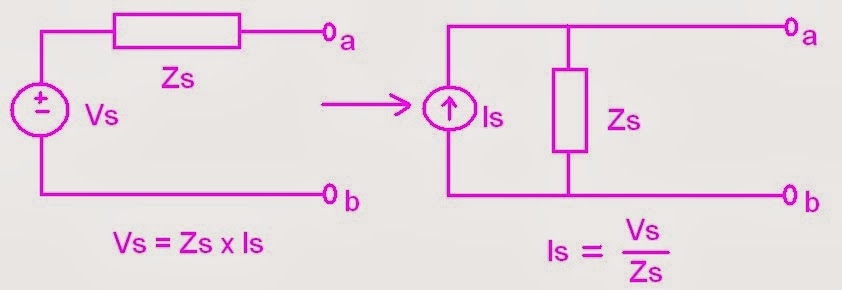
Illustration:
Example:
Vx is our unknown in the given circuit. We have to simplify this
circuit to obtain Vx.
* means series
3Ω * j4 Ω
Z1 = 3 + j4 Ω
4 Ω * -j13 Ω
Z2 = 4 + -j13 Ω
As we can see from
the circuit, It has a voltage source with series resistor. We will transform it
into a current source with a resistor as what illustration above shows. Using
ohm's Law we have;
I = (20∠-90) /
5 = -j4 A

5 Ω // (3+ j4 Ω)
Z3 = (3+ j4) (5) / (3+ j4) + (5)
Z3 = 2.5 + j1.25 Ω
V = (-j4) x (2.5 + j1.25)
V = 5 - j10 V

(2.5 + j1.25 Ω) * (4 + -j13 Ω)
Z4 = (2.5 + j1.25) + (4 + -j13)
By this time, we will apply voltage division.
Vx = ( Zx ) (Vs) / (Zx) + (Z)
Vx = ( 10 ) (5 - j10) / ( 10 ) (6.5 -
j11.75)
Vx = 5. 519 ∠ -27.98 V
I've
learned that in solving unknown in Ac circuit, we can also use source transformation.
For me this is much easier to use than to the other in simplifying the circuit
because it lessen your time making solutions. It gives you many illustrations
how the circuit changes while solving the problem. Ohm's Law is the most
formula we used in here so it is quiet easy. Source transformation can be use
for checking your circuit if you are confused.
Subscribe to:
Posts (Atom)


