
Saturday, March 15, 2014

Saturday, March 8, 2014
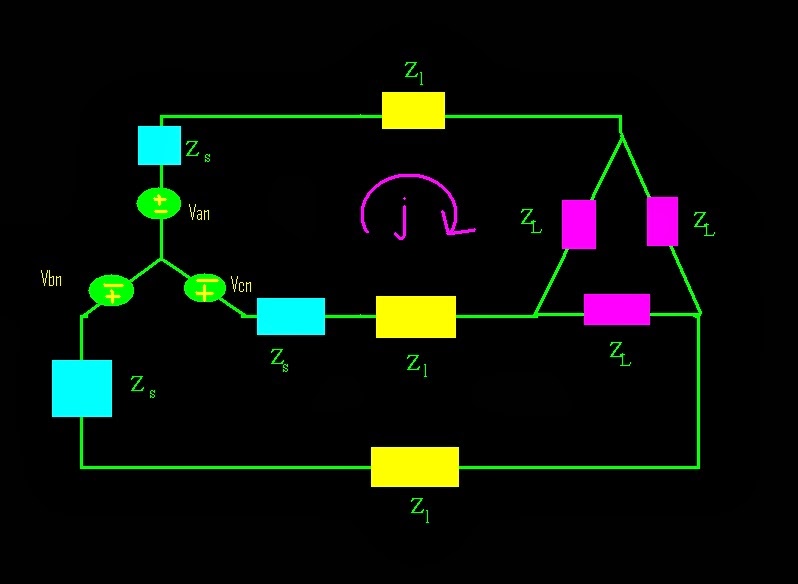
DELTA-WYE Connection


example,
A balanced Y-connected load with a phase impedance of is 40 + j 25 ohmssupplied by a balanced, positive sequence -connected source with a linevoltage of 210 V. Calculate the phase currents. Use
Vab as reference.




Saturday, March 1, 2014
WYE-WYE connection


A Y-connected balanced
three-phase generator with an impedance of 0.4+j 0.3 ohms per phase is
connected to a Y-connected balanced load with an impedance of 24- + j19 ohms
per phase. The line joining the generator and the load has an impedance of 0.6
+ j0.7 ohms per phase. Assuming a positive sequence for the source voltages and
that Van = 120 ∠ 30 ° V, find : (a)
the line voltages, (b) the line currents.


.jpg)


Friday, February 21, 2014
Power Measurement
Every house has its own bill provided by their electric utility
company. And every month, we are paying for it. But, are you not wonder why
there is no such a list of appliances in the electric bill? Like… 1. Electric iron
2. air conditioner and etc.? Well, probably
none and it will never happen because they are categorize by …… and they are charge
in a different rate for each kilo-watt hour (kWh) used. A kilo-watt hour (kWh)
is 1000 watts of energy used in a one hour period. A 1000 watt appliance that is turned on for 1
hour equals 1 kilo-watt hour. Well, that’s probably our oven toaster or
electric iron. They are just LIKE A BOSS!!
But so much for that, consumers are
operating many appliances, and it gets measured by the electric meter. But
the problem is some consumers do not know how electric bill comes up with that
amount of charge per month.
For those who are not fun with mathematics, but wanted to know
how exactly electric bills are calculated. a li'l mathematics can be apply.
We called it ohm’s Law:
Voltage (V) = current (I) x Resistance (R)
Power (P) = current (I) x voltage (V)
Voltage (V) unit is Voltage/ V
Current (I) unit is
Ampere/ A
Resistance (R) unit is
Ohms/ Ω
Power (P) unit
is Watts/ W
Sometimes you notice at the back portion of your appliances, you
will see some of the listed above. Lucky
you if you will saw the wattage of it but if it is not, you will force yourself
to do calculations. Sometimes voltage and current rating are given. So, you
will just multiply the two as shown above to get the power rating.
A
consumer consumes 1000 watts load per hour daily for one month. Calculate The
Total Energy bill of the consumer if per unit rate is 9 in $ [Take 1 month = 30
Days]
Solution
1unit =
1kWh.
So
Total kWh = 1000 x 24 x 30 = 720000 watts/hour
we Want
to convert it into Units, Where is 1unit = 1kWh.
So total Consumed units. 720000/1000...... (k=kilo=1000)
Total Units = 720.
Cost of per unit is 9.
So total Cost or bill= 720 x 9 = 6480 $
So total Consumed units. 720000/1000...... (k=kilo=1000)
Total Units = 720.
Cost of per unit is 9.
So total Cost or bill= 720 x 9 = 6480 $
(1000
watts for 1 hour = 1kWh = 1 unit of Energy) So if the rate of unit is 5
Dollars, then you will pay 5 Dollars as a bill for your bulb.
Subscribe to:
Posts (Atom)